
Review · MEXICO CITY
Mexico City: Hidden Markets, Street Food & Salsa-Making Tour
Mexico City’s best food stories often begin away from the postcard sights. This five-hour outing takes you into two working markets, past murals linked to Diego Rivera’s students, onto the Metro, and into a family food business where you make salsa with a molcajete. It is a city tour told through breakfast, flowers, public transport, and lunch.
I like the mix of street food and social history, especially at the first market, where murals share space with everyday services such as a daycare and auditorium. I also like that you learn to use the Metro instead of simply watching the city through a tour vehicle.
The main caution is the amount of walking. The route covers about 6 kilometers, much of it through busy market aisles and city streets, and the food costs are not broadly included unless specifically stated. Two late-cancellation incidents also point to a rare but serious communication risk, so confirm the tour before leaving your hotel.
Key points at a glance
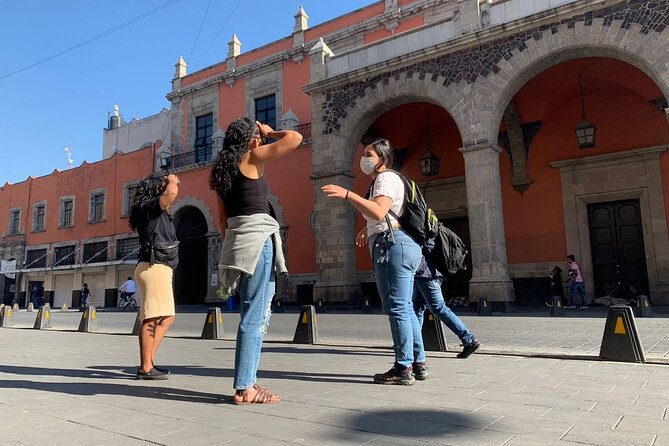
- Murals inside a working market: See 1,450 square meters of artwork at Mercado Melchor Muzquiz, also described as the Abelardo Rodríguez Market.
- Two very different markets: One centers on murals and public life, while Mercado Jamaica combines flowers, produce, and prepared food.
- Street food with range: Expect tamales, atole, tacos, huaraches, fruit, and pineapple tepache.
- A real salsa lesson: Wash, cut, grill, and crush ingredients by hand in a traditional molcajete.
- Useful Metro practice: You ride Mexico City’s subway with a guide who explains how to navigate it.
- Small-group format: The maximum is 12 people, with English guidance and a 5-hour schedule.
Why this Mexico City market tour feels different
Many food walks in Mexico City stay near famous restaurants and easy-to-find stalls. This one sends you into places that are part of ordinary city life. You see vendors arranging flowers, families buying produce, cooks preparing breakfast, and small businesses serving their regular customers.
That makes the tour useful beyond the food itself. You learn how markets function as social spaces, how ingredients move from farms to city tables, and how a traditional dish fits into daily life. The guide also fills in the city’s political and artistic background, particularly at the first market.
The guide can shape the quality of the day. Andrea has been praised for her clear English and enthusiasm for Mexico, while Axel has been singled out for his warm manner and strong connection with the market community. Viri has focused on food, murals, architecture, and Metro instruction. Alfonso, also called Victor in some experiences, has been especially good at linking the food stops with city history.
Those names are useful when checking the current departure details, but guides can change. What you should expect is an English-speaking local guide leading a small group through places that are difficult to understand on your own.
More Hidden Food Spots in Mexico:
- Mexico Off the Beaten Track: Street Food & Bikes — All Inclusive
★ 5.0 · 14 reviews - 🟢Mexico Off The Beaten Track/ Street Food Bike Tour 🟢
★ 5.0 · 4 reviews - Hanoi: Street Food Tour with Train Street & Hidden Alleyways
★ 5.0 · 2,831 reviews
The first stop: Mercado Melchor Muzquiz and its murals
The opening market is listed as Mercado Melchor Muzquiz and is also described as the Abelardo Rodríguez Market. It is not simply a place to buy food. Its unusual design includes a daycare and auditorium, and its walls hold about 1,450 square meters of murals.
This is where the tour shifts from eating to interpretation. You hear about Mexico City’s social and political life in the early 20th century, along with the market’s connection to Diego Rivera and Frida Kahlo. Several visitors have especially valued seeing murals and sculptures created by students of Rivera, work that can be easy to miss without someone pointing it out.
You begin with tastings of tamales and atole. A tamale gives you a soft, corn-based breakfast with a filling, while atole is a warm traditional drink made from masa. It is a fitting start: simple, filling, and tied to everyday Mexican food rather than restaurant presentation.
Give yourself time to look upward and around. The artwork is the point here, but the market’s practical features matter too. This is a functioning community place, not a gallery arranged for sightseeing. That can mean noise, crowded passageways, and a less polished setting. For me, that trade is worthwhile if you want to see how art and public life share the same space.
Mercado Jamaica: flowers, produce, and prepared food
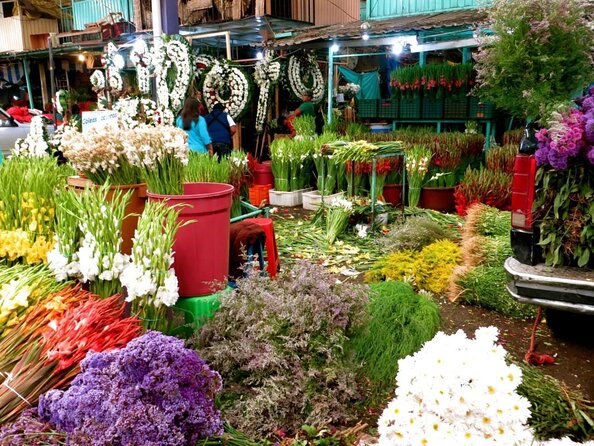
The second major stop is Mercado Jamaica, reached by public transport. The market is known as a three-part experience, with flowers, fresh produce, and prepared food all under one broad market world.
The flower section supplies the most immediate color. One of the tour’s playful details is asking a vendor to choose flowers that match your eye color. It is a small exchange, but it gives you a reason to speak with a seller rather than simply walk past the displays.
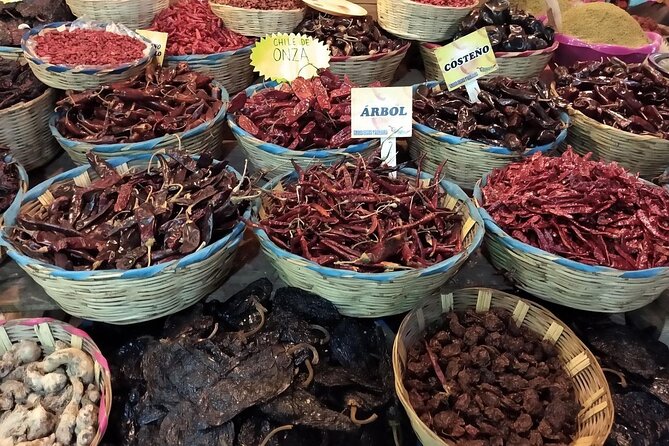
From there, you move through stalls selling vegetables, fruit, and ready-to-eat food. The guide explains local farming practices while you select fresh ingredients for the salsa lesson. That makes the cooking class feel connected to the market rather than added on as a separate activity.
Food tastings can include tacos, fresh fruit, pineapple tepache, and other market bites. Green chorizo has been a memorable choice for some people, and coffee de olla has also appeared during the food portion. The exact menu can vary with vendors and the day’s arrangements, so do not treat every listed item as guaranteed.
Mercado Jamaica is large and active. You will be walking through narrow areas, stopping at stalls, and keeping track of your group. Wear shoes with good soles, carry water, and keep your belongings close. The advice to leave your passport, extra cards, and valuables at your hotel is sensible. Bring only a small amount of spending cash.
The food: breakfast, snacks, and a proper finish
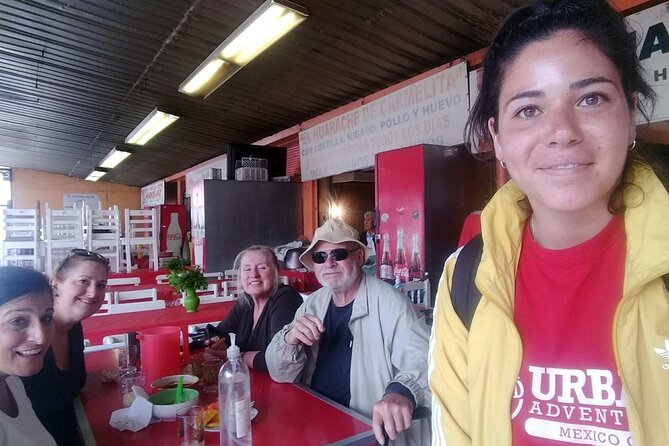
This is a good tour for anyone who wants to sample several classic foods without ordering full meals at each stop. The tastings can include tamales, atole, tacos, huaraches, fruit, and tepache, with coffee de olla appearing on some departures.
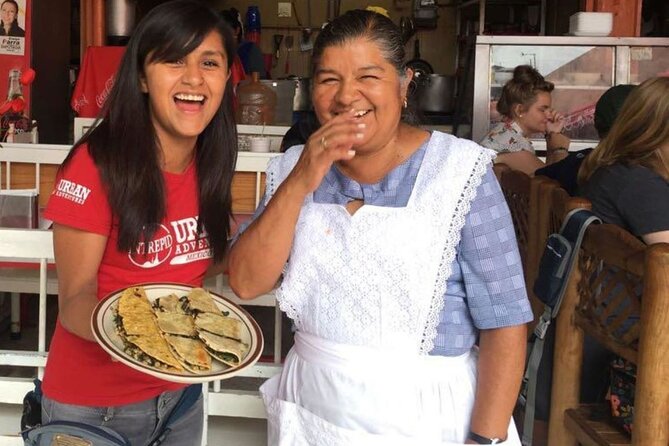
A huarache is a thick masa base topped with ingredients, often served as a substantial street meal. Here it also becomes the partner for your homemade salsa. That is a smart choice because you can taste the sauce on a familiar local dish instead of taking it home in a container and guessing how it should be used.
The tour information says food and drinks are not included unless specified, so ask what the current price covers before ordering extra items. Reviews describe the outing as providing breakfast, drinks, lunch, and a salsa-making snack, but the safest approach is to carry some pesos for food purchases and market samples.
You should also tell the operator about vegetarian, gluten-free, or lactose-free needs at least 24 hours ahead. The tour says these can be accommodated, but advance notice is required. Do not wait until you are standing at a stall to explain a serious dietary restriction.
More street food walks around Mexico:
- Cancun Taco Tour, Local Beer and Night Market with Transportation
★ 5.0 · 816 reviews - Cancun Street Food Tour with Food Stalls, Local Market and Murals
★ 5.0 · 723 reviews - Mexican Cooking Class with Food Market Visit in Mexico City
★ 5.0 · 506 reviews - Merida Street Food Walking Tour
★ 5.0 · 417 reviews
Making salsa with a local family
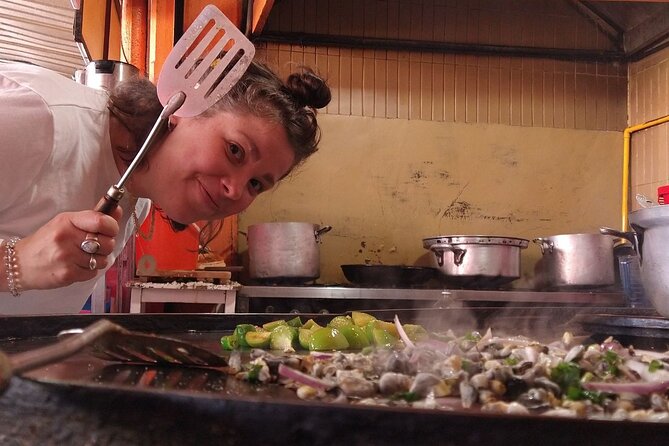
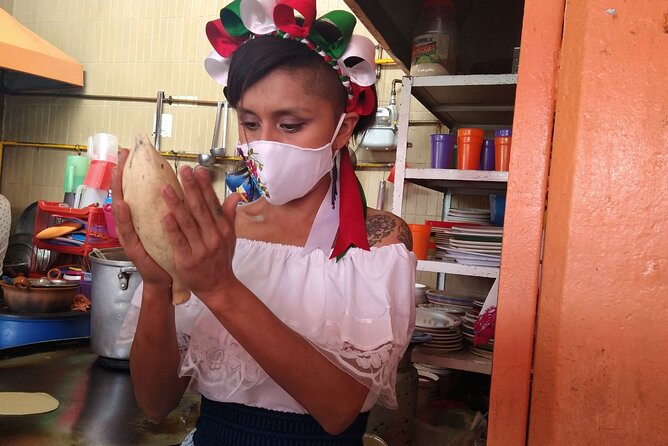
The cooking portion is the heart of the experience. After buying vegetables at Mercado Jamaica, you visit a family business with nearly a century of tradition. You wash, cut, and grill the ingredients, then crush them in a molcajete.
That sequence matters. A blender can make salsa quickly, but the molcajete gives you a feel for the ingredients and the effort behind the dish. You learn how the texture changes as the vegetables and seasonings are ground together. The lesson is hands-on, patient, and practical rather than a demonstration where you only watch.
The family business is also one of the tour’s strongest human connections. The people teaching the lesson have been described as patient and welcoming, and the salsa is served with a classic huarache. This is the point where the market purchases become a meal and the meal becomes a skill you can repeat at home.
Do not expect a formal cooking school. The setting is a local food business, and the pace may depend on the group and the family working there. That informality is part of the appeal, though anyone hoping for a polished kitchen lesson may find it basic.
Riding the Mexico City Metro
The Metro ride is not just a transfer between attractions. Your guide shows you how to use Mexico City’s subway, which can be one of the most useful parts of the morning for a first visit.
You learn by doing: meeting the guide near the Centro Histórico, boarding public transport, and reaching Mercado Jamaica as part of the group. Guides such as Andrea and Alfonso have helped people feel more comfortable using the system later in their trip.
The train ride also changes your view of the city. Instead of moving in a private vehicle, you share a common form of transport and see how residents get around. It is practical, inexpensive, and more revealing than a sealed tour bus.
The Metro can be crowded, and you need to stay alert with bags and phones. If you are not comfortable standing or walking through stations, consider that before booking. The tour calls for a moderate fitness level and roughly 6 kilometers of walking, so this is not a sit-down food crawl.
Timing, meeting points, and what to wear
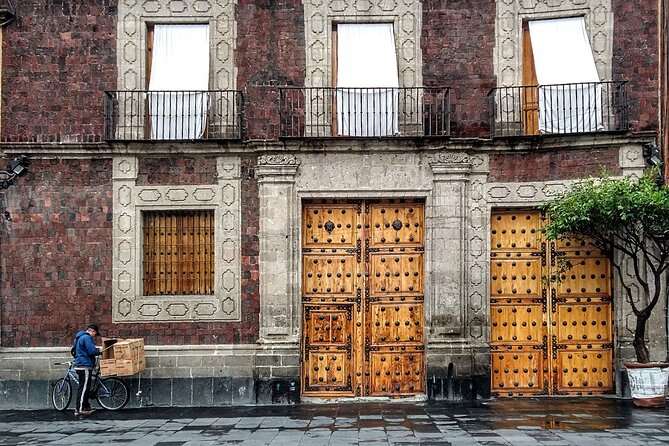
The experience begins at 8:30 a.m. at República de Guatemala 4 near Mexico City’s Centro Histórico. It ends at the facade of Palacio de Bellas Artes on Avenida Juárez, a useful central location for continuing your day.
The scheduled duration is about five hours. Starting in the morning works well because the first food tastings function as breakfast, and you finish with a filling huarache and salsa. You should eat lightly beforehand, or not at all if you are comfortable doing so.
Dress for the markets, not for a formal city tour. Long trousers or jeans and a T-shirt are recommended, with comfortable walking shoes. During the rainy season, from May through September, bring a raincoat or umbrella.
Only small cameras are suitable. Large professional equipment is not recommended in the markets, where space is limited. A phone or compact camera is more practical and less intrusive.
Price and overall value at $69.45
At $69.45 per person, the tour is not the cheapest way to buy street food in Mexico City. If all you want is a taco and a Metro ride, you can spend far less on your own.
The value comes from the access and explanation. Your fee brings together two markets, an English-speaking guide, public transport instruction, historical context, several tastings, and a family salsa lesson. You are also supporting independent vendors and a family-run business, which gives the spending a direct local benefit.
A small group capped at 12 improves the experience. You have a better chance to hear the guide in the market, ask questions about food or murals, and take part in the molcajete lesson. Some departures may be smaller, and one reported experience had only two people, though that should not be expected.
The price makes the most sense early in your Mexico City stay. You get an introduction to the Metro, a list of foods to look for later, and practical knowledge about markets. It is less useful for someone who already knows Mercado Jamaica, regularly uses the Metro, and prefers to explore food stalls without a guide.
Who should book this experience
You should consider it if you want several parts of Mexico City in one morning: art, food, public transport, shopping, and conversation with local businesses.
It suits solo visitors particularly well because the small group and guide provide structure without the formality of a large bus tour. Families can also enjoy it, and one family group ranging from age eight to 56 found the walking manageable. Still, children should be comfortable with a long morning on foot and in crowded public places.
This is a good fit for food lovers who want to try multiple traditional dishes, not just sit down for one meal. It is also useful for first-time visitors who feel unsure about the Metro or want help understanding the city’s markets.
You may want a different activity if you need guaranteed indoor comfort, dislike public transport, have difficulty walking 6 kilometers, or want every food and drink cost bundled into the price. The route is local and practical, which means it can also be noisy, crowded, and less predictable than a standard sightseeing tour.
Should you book the market and salsa tour?
I would book it for the first or second day of a Mexico City stay, especially if murals, street food, and everyday city life appeal to you. The strongest parts are the art-filled first market, Mercado Jamaica’s flowers and produce, the Metro lesson, and the hands-on salsa preparation.
Book with realistic expectations about walking, cash, weather, and changing food stops. The tour has a 4.8 rating from 310 reviews and is recommended by 95 percent of participants, but two November 2025 departures had serious problems when the guide did not arrive and communication failed. The operator apologized and attributed those cases to a last-minute cancellation.
That appears to be unusual, but it is worth confirming the departure shortly before the start time. If you want a friendly, food-centered introduction to Mexico City with practical transport help, the experience offers strong value at $69.45.
FAQ
How long does the Mexico City market tour last?
The experience lasts approximately five hours and begins at 8:30 a.m.
Where does the tour begin?
The meeting point is República de Guatemala 4 in Mexico City’s Centro Histórico, near the Hostel Mundo Joven facade.
Where does the tour end?
The tour ends at the Palacio de Bellas Artes facade on Avenida Juárez in the Centro Histórico.
Which markets does the tour visit?
The route includes Mercado Melchor Muzquiz, also described as the Abelardo Rodríguez Market, and Mercado Jamaica.
What food and drinks can I expect?
Tastings can include tamales, atole, tacos, huaraches, fresh fruit, and pineapple tepache. Coffee de olla and green chorizo tacos have also appeared during the food portion.
Is the salsa-making lesson included?
Yes. You prepare salsa with a local family by washing, cutting, grilling, and crushing ingredients in a molcajete.
Is public transport part of the experience?
Yes. The group rides the Mexico City Metro, and the guide provides practical help with using and navigating it.
How much walking is involved?
The tour covers about 6 kilometers, or 3.7 miles, through markets and city streets. A moderate fitness level is recommended.
Can dietary restrictions be accommodated?
Vegetarian, gluten-free, and lactose-free requests can be accommodated if you provide notice at least 24 hours before the tour.
Newest street food walks around Mexico
- Private Street Food & Mural Art Tour in Mexico City★ 3.5 · 3 reviews
- Mexico City Street Food Tour Adventure★ 5.0 · 12 reviews
- Private Half-Day Traditional Markets Street Food Tour in Mexico City★ 3.0 · 2 reviews
- Night Street Food & Bike Tour / Small Groups /All Inclusive★ 5.0 · 25 reviews
- Mexico Off the Beaten Track: Street Food & Bikes — All Inclusive★ 5.0 · 14 reviews
- El Centro Street Food Walking Tour★ 5.0 · 10 reviews
- Private Street Food Tour Merida – Best Rated★ 3.0 · 6 reviews
- Street Food Bike Ride/Roma-Condesa/All-Inclusive 3.5 hours★ 5.0 · 9 reviews
Mexico City street food tours, side by side.
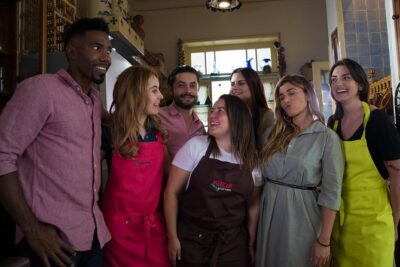
Mexican Cooking Class with Food Market Visit in Mexico City
Read our review →
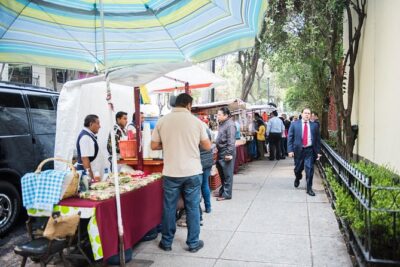
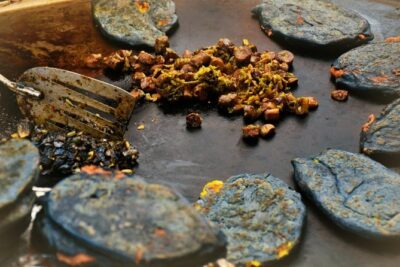
Mexico City Vegan & Vegetarian Street Food Adventure
Read our review →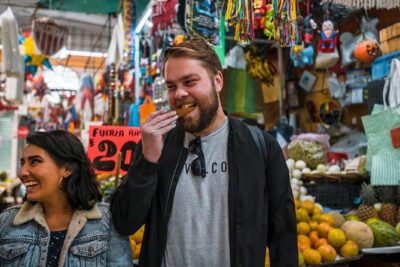
Street Food Bike Tour / Mexico is not only Tacos / All Inclusive
Read our review →
Night Street Food & Bike Tour / Small Groups /All Inclusive
Read our review →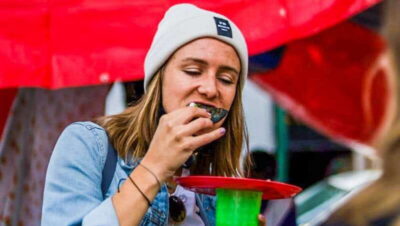
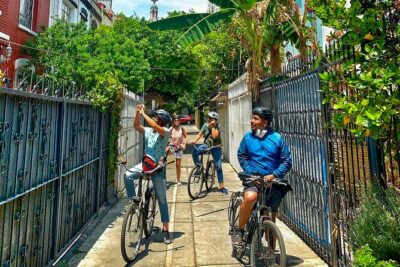
Mexico Off the Beaten Track: Street Food & Bikes — All Inclusive
Read our review →The lists this tour appears in