
Review · MALTA
The Valletta Street Food and Culture Walking Tour
Valletta’s best introduction may come one bite at a time. This three-hour walk pairs Maltese street food with the city’s churches, squares, and stories, so you are not simply eating in a series of cafés. You are learning why pastizzi, ftira, spiced coffee, and rabbit belong to Malta’s food culture.
I like the easy meeting point at the New Parliament Building and the small maximum of 16 people. I also like that the tour ends in central Valletta, leaving you the afternoon to visit museums, wander Republic Street, or take in more of the city. The main consideration is the food: this is not a good match for a vegan diet or gluten intolerance, and the quantity may replace lunch.
Key points to know
- Pastizzi starts the morning: You try Malta’s most famous savory pastry soon after meeting your guide.
- Food and landmarks share equal billing: Castille Square, Auberge d’Italie, Merchant Street, and other central sights are woven into the walk.
- The tastings are generous: Plan on eating enough to count as a full meal, not just a few small samples.
- The menu changes: The final restaurant stop may include rabbit, ravioli, a local platter, or another traditional dish.
- Headphones can help: Some guides use them so you can hear clearly while walking through busy streets.
- The timing works well: A 9:30 am start finishes around lunchtime, leaving the rest of your day open.
Why this Valletta food walk works as a first introduction
Valletta is compact, but its streets carry more stories than you can absorb by simply following a map. A guide can point out how Malta’s food reflects its island setting, Mediterranean connections, and long contact with outside powers. Here, those explanations arrive alongside something to taste.
That combination is the real strength of the experience. You get a basic orientation to Valletta while your guide explains local dishes and customs. Guides including Ernest, Marisa, Nadine, Mariella, John, and Charlotte have led this experience, and the tone can vary with the person in charge. The strongest guides are warm, clear, and good at linking food to place.
I particularly like the relaxed pace. The walk is broken up by stops, so you are not racing from landmark to landmark. At the same time, you cover enough ground to see several important parts of central Valletta.
The group limit is 16 people. That is large enough to keep the price below that of a private tour, but still manageable for a walking experience. Some guides use audio headphones, a useful touch when the group spreads out or when you are standing on a busy street.
More street food walks around the world:
- Dubai: Old Town, Creek, Museums, Souks, & Street Food Tour
★ 4.8 · 10,816 reviews - Ho Chi Minh City Street Food Tour & Sightseeing By Motorbike
★ 5.0 · 9,413 reviews - Medellin: Comuna 13 Graffiti Tour, Cable Car & Street Food
★ 4.8 · 9,046 reviews
Meeting at the New Parliament Building at 9:30 am
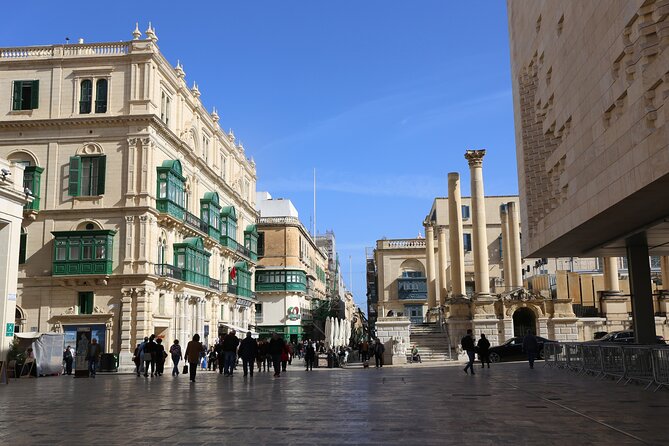
You meet your guide at the entrance to Valletta, in front of the New Parliament Building on Republic Street. This is a practical departure point, especially if you are staying in or near the city center, and the tour description calls it easy to find.
The early start gives you a useful advantage. Valletta’s streets are generally easier to navigate before the day gets too far along, and you finish after roughly three hours. You can then use the rest of the day for a museum, church, harbor view, shopping, or a second meal that does not involve a pastry.
The route ends at St. George’s Square on Republic Street, close to the center and local amenities. That makes the tour easy to combine with other sightseeing. You do not need to arrange transport back to a distant suburb or hotel area.
Wear comfortable shoes. The walk is in Valletta’s historic center, and one account specifically warns you to expect lots of steps. The city’s slopes and stairways are part of the setting, but they are worth keeping in mind if walking uphill is difficult.
Pastizzi: the right way to begin

The first food stop introduces you to pastizzi, Malta’s famous savory snack. It is a small pastry, usually eaten casually and often treated as an everyday local bite rather than a formal dish.
That makes it a smart opening course. Your guide can explain the place pastizzi holds in Maltese food culture while you try it fresh at the start of the route. One version mentioned on the tour is filled with mushy peas, a detail worth noting if you normally associate pastries with sweet fillings.
Pastizzi are filling, so do not arrive after a large breakfast. You will be eating throughout the morning, and the later stops are substantial. I would keep breakfast light and bring water, particularly in warm weather.
The stop itself is not a museum visit or formal attraction. No admission ticket is required, and the focus is on tasting and explanation. That is typical of this experience: you see Valletta from the street rather than spending time inside each major building.
Castille Square and Auberge d’Italie with a food story
After the first tasting, the walk continues through central Valletta, including Castille Square and the Auberge d’Italie. These are not random backdrops. They help place Malta’s political and cultural story around the food you are eating.
The guide provides a broad introduction to Valletta and Malta as the group moves through the city. You may hear about the Knights, the role of the city, and the ways outside influences shaped local customs. The quality of this part depends on your guide’s approach. Charlotte, for example, has been praised for adding family stories and local detail, while some people may find her opinions about the Knights stronger than they prefer.
That is a fair point to consider. A guide brings a personal voice, and history told on a walking tour is not the same as a museum label. If you prefer a strictly neutral presentation, you may notice a guide’s interpretation. If you enjoy a more personal account, that can make the city feel less remote.
The walk remains focused on central Valletta, so the landmarks arrive without a long transfer between them. You are learning while moving, rather than sitting through a long lecture.
Same streets, a different set of bites:
- Dubai: Old Town, Souks, Street Food, Guided Tour & Abra Ride
★ 4.9 · 7,170 reviews - Naples: Street Food Walking Tour with Local Guide
★ 4.9 · 4,976 reviews - Small Group Hanoi Street Food Tour with a Real Foodie
★ 5.0 · 4,682 reviews - Rome: Street Food Tour with Local Guide
★ 4.8 · 4,077 reviews
Merchant Street and the taste of ftira
Merchant Street is the setting for another food and sightseeing section. Here the guide blends the city’s built environment with Maltese cuisine, explaining the landmarks as you go.
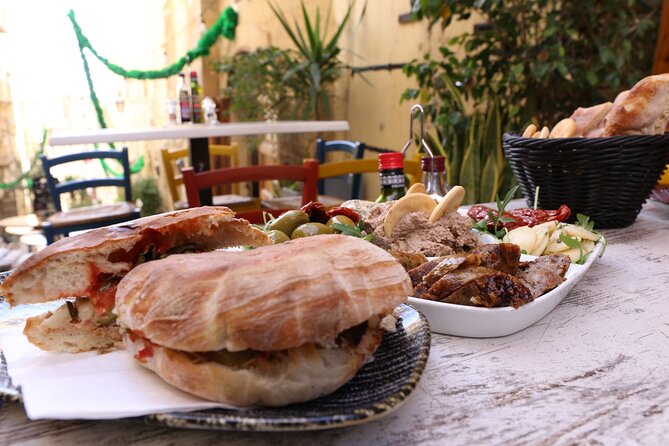
The featured food is ftira, a flat bread filled with Mediterranean ingredients. It is one of the more useful tastings because it feels closer to an everyday meal than a novelty sample. The exact filling can vary, and one account recalls a memorable tuna sandwich served at a small street-side restaurant. You should treat that as a possible style of tasting rather than a guaranteed menu item.
Ftira also helps explain Malta’s food as practical island cooking. Bread, fish, vegetables, and other regional ingredients come together in a format that is easy to eat while walking or sitting at a modest local spot. Your guide will serve it with Kinnie, Malta’s distinctive soft drink.
Kinnie is an important part of the experience because it is not simply another generic soda. Its bitter, herbal character may surprise you if you expect a sweet cola. This is the kind of local drink that is worth trying with an open mind, even if it does not become your new favorite.
The stop lasts about 40 minutes, enough time to eat and listen. Some people prefer to hear the food explanation before the plate arrives. Here, the guide may explain items while you are already eating, so ask questions if you want a closer description of what is in front of you.
Spiced coffee and a sweet Maltese finish
The next stop turns to coffee and dessert. You learn about Malta’s particular spiced coffee tradition, then sample mqaret or another seasonal sweet.
Mqaret is made with dates, cinnamon, and orange blossom water. It has a very different character from pastizzi and ftira, giving the tour a useful shift from salty food to fragrant sweetness. The date filling makes it satisfying, so you may already be feeling quite full by this stage.
There is one small ordering quirk to know about. The dessert may arrive before the final savory restaurant course. One person specifically wished the sweet had come last, so you should not expect a perfectly staged meal in the usual starter, main, dessert order.
Still, the variety is a plus. You are not eating five versions of the same pastry. The tour moves from a savory snack to bread, soda, coffee, sweets, beer, and a more substantial traditional dish. That range gives you a better sense of Maltese eating habits than a single restaurant meal would.
The final restaurant course can replace lunch
The tour ends at a local restaurant in central Valletta with a platter, tapas-style food, a glass of Cisk lager, and one traditional Maltese dish. The menu changes from day to day, which keeps the experience from being completely fixed but means you cannot choose the exact final course in advance.
Possible dishes include rabbit or ravioli. Rabbit is one of the foods most closely associated with Maltese cooking, and it is a worthwhile choice if you want to try something tied to the island rather than a familiar international dish. The menu may also include modern touches, such as rabbit terrine, rather than only a basic home-style preparation.
The final stop is where the value becomes clearer. At $66.51 per person, you are paying for a licensed guide, a three-hour walking tour, several food stops, Kinnie, beer, and a substantial local dish. If you count everything as a collection of tiny bites, the price may seem high. If the food replaces lunch and the guide gives you a useful orientation to Valletta, it is a reasonable group-tour price.
Come hungry. Multiple people found the food more than enough for a full meal, and that is the practical message I would take seriously. A heavy breakfast could leave you uncomfortable before the final restaurant stop.
What the guides add to the experience
The guide is central to the quality of this tour. Food alone would not justify walking through Valletta for three hours, and landmarks alone would not give you much of a taste of everyday Malta.
Ernest is described as relaxed, professional, and good at explaining how local food connects to history and culture. Marisa is known for an energetic and welcoming approach, with personal stories that help make Malta’s past easier to follow. Nadine has also helped with practical matters such as arranging a taxi, a useful courtesy if you need assistance after the walk.
Other guides may lead the tour, including John, Mariella, and Charlotte. The names matter because the experience is not delivered by one fixed personality every day. The general format stays the same, but the balance between formal history, family stories, humor, and personal opinion can shift.
Headphones are used on some tours. I consider this a real advantage. You can stand slightly apart, avoid crowding around the guide, and still hear the explanation. That matters in a group of up to 16 people, particularly on narrow streets.
Dietary limits, children, and practical fit
This tour is not recommended for vegans or people with gluten intolerance. You should tell the provider about dietary needs when booking, but the available information does not promise that the menu can be adapted. If food restrictions are central to your decision, ask before paying rather than hoping the stops can be changed on the day.
Children up to age five may join free, but they do not receive the included food portions. That makes the tour more suitable for children who can manage a long walking morning and are happy to share or eat separately.
Most people can participate, and service animals are allowed. The tour is also near public transportation. No museum or church entrance fees are included, but that is not a serious drawback if you want a street-level introduction rather than a full sightseeing pass.
The experience is offered in English. Confirmation is provided when you book, and the group has a maximum of 16 people.
Cancellation and planning details
Free cancellation is available up to 24 hours before the local start time for a full refund. Changes or cancellations inside that 24-hour window are not accepted for a refund.
The tour requires a minimum number of participants. If that minimum is not met and the experience is canceled, you are offered another date or experience, or a full refund.
I would schedule this near the beginning of your Malta stay. The route gives you a useful sense of Valletta’s layout, introduces several foods you may want to seek out again, and finishes early enough for you to return to a favorite spot later.
Should you book the Valletta Street Food and Culture Walking Tour?
Book it if you want a substantial food experience and a city orientation in one morning. It is especially useful for a first day in Valletta, for people who like local snacks more than polished restaurant dining, and for anyone who wants history explained while walking rather than from a bus.
The strongest reasons to go are the range of food, the central route, the relaxed three-hour length, and the chance to try rabbit, Kinnie, ftira, pastizzi, and Maltese sweets without planning each stop yourself. The 97 percent recommendation rate and 4.9 rating also suggest that the format works very well for most people.
Skip it if you need a vegan or gluten-free menu, dislike group tours, or want a strict, academic account of Maltese history. Also skip breakfast or keep it very small. This is a food tour in the fullest sense, and by the time you reach St. George’s Square, you may need nothing more than a quiet afternoon walk.
FAQ
Where does the tour start?
It starts at 9:30 am in front of the New Parliament Building on Republic Street at the entrance to Valletta.
Where does the tour end?
It ends at St. George’s Square on Republic Street in central Valletta, close to amenities and the main square.
How long does the tour last?
The tour lasts approximately three hours, although some departures may run to about three and a half hours.
What food is included?
Food may include pastizzi, ftira, mqaret or another seasonal sweet, a local platter, tapas-style items, and a traditional dish such as rabbit or ravioli.
Are drinks included?
Yes. The tour includes local drink Kinnie and a glass of Cisk lager, along with the food tastings.
Is lunch included?
The final restaurant stop provides enough food to function as a full meal for many people, but the experience is described as tastings rather than a separate formal lunch.
Is the tour suitable for vegans?
It is not recommended for clients on a vegan diet.
Is the tour suitable for people with gluten intolerance?
It is not recommended for people with gluten intolerance. You should provide any dietary information when booking.
Can children under five join?
Children up to age five can join free, but food items are not provided for nonpaying children.
How many people can join the tour?
The maximum group size is 16 people.
Are entrance fees included?
No. Entrance fees to museums or churches are not included, although the walking tour itself does not require admission tickets.
Can I cancel for a refund?
You can cancel up to 24 hours before the local start time for a full refund. Cancellations or changes made less than 24 hours before the start are not accepted.
Newest street food walks around the world
- Old Delhi Cultural, Temples, Heritage Walking Street Food Tour★ 5.0 · 57 reviews
- Old and New Delhi Street Food Sampling★ 5.0 · 3 reviews
- Old Delhi Tour by Tuk-Tuk Street Food and Shopping Experience★ 5.0 · 12 reviews
- Customized Half Day and Full Day Delhi Shopping, Street Food Tour★ 5.0 · 52 reviews
- Delhi: Street Food Crawl (2 Hours Guided Food Tasting Tour)★ 3.5 · 18 reviews
- Taste Famous & Best Street Food of Old Delhi (Jama Masjid)★ 3.0 · 2 reviews
- Spice & Stories: 3-Hour Old Delhi Heritage Food Walk Guided Tour★ 4.5 · 36 reviews
- Old Delhi Street Food and Spice Market Tour★ 5.0 · 81 reviews